
ACS Organic Chemistry Study Guide PDF: A Comprehensive Plan
Navigating the ACS organic chemistry exam requires focused preparation. Utilizing PDF study guides, alongside practice exams and understanding core concepts, is crucial for success.
Embarking on your ACS Organic Chemistry journey demands a solid foundation. This exam comprehensively assesses your understanding of organic principles, reaction mechanisms, and spectroscopic techniques. A well-structured study plan, leveraging PDF resources, is paramount. Many students find the breadth of the material daunting, necessitating a focused approach.
PDF study guides offer a convenient and portable way to review key concepts and practice problems. They often include detailed explanations, reaction summaries, and practice questions mirroring the exam’s format. Remember, success isn’t solely about memorization; it’s about applying principles to solve novel problems. Mastering core concepts like structure, bonding, and functional groups is essential. Consistent practice and strategic utilization of available resources will significantly enhance your performance.
II. Understanding the ACS Exam Format
The ACS Organic Chemistry exam primarily consists of multiple-choice questions, demanding both conceptual understanding and problem-solving skills. Familiarity with the question types is crucial; expect questions testing reaction mechanisms, spectroscopic data interpretation, and synthesis planning; PDF study guides often include practice exams mirroring this format, allowing for realistic preparation.
Furthermore, the exam incorporates free-response questions requiring detailed explanations and step-by-step solutions. These assess your ability to articulate organic chemistry principles. Effective time management is vital, as the exam is time-constrained. Analyzing past exams (often available in PDF format) reveals recurring themes and question styles. Understanding the scoring rubric helps prioritize content and refine your approach.
III. Core Concepts in Organic Chemistry
A solid grasp of fundamental organic chemistry concepts is paramount for ACS exam success. These include structure and bonding – understanding hybridization, resonance, and molecular geometry. Mastery of alkanes, alkenes, and alkynes, including nomenclature and reactivity, is essential. A detailed overview of functional groups – alcohols, ethers, aldehydes, ketones, carboxylic acids, and amines – and their characteristic reactions is also critical.
PDF study guides excel at systematically presenting these concepts, often with illustrative examples and practice problems. Focus on understanding reaction mechanisms, not just memorizing them. Strong foundational knowledge in these core areas will significantly improve your ability to tackle complex exam questions and synthesize information effectively.
III.1. Structure and Bonding
Understanding structure and bonding is the bedrock of organic chemistry. This involves grasping atomic orbitals, hybridization (sp, sp2, sp3), and how these dictate molecular geometry. Resonance structures are crucial for delocalizing electrons and stabilizing molecules – PDF guides often visualize these clearly. Bond polarity, influenced by electronegativity, impacts reactivity.
Lewis structures are fundamental for representing bonding, and understanding formal charge helps predict stability. Explore VSEPR theory to predict molecular shapes. A strong foundation here allows you to predict reactivity and interpret spectroscopic data. PDF study materials provide ample practice with drawing structures and predicting properties.
III.2. Alkanes, Alkenes, and Alkynes
Alkanes, alkenes, and alkynes form the foundation of hydrocarbon chemistry. Alkanes, saturated hydrocarbons, exhibit conformational isomerism – PDF guides detail their stability. Alkenes, containing carbon-carbon double bonds, display geometric isomerism (cis/trans) and are more reactive due to pi electrons. Alkynes, with triple bonds, are even more reactive and exhibit linear geometry.
Nomenclature (IUPAC naming) is vital; practice naming and drawing these compounds. Understand reactions like addition to alkenes and alkynes. PDF resources provide reaction maps and mechanisms. Mastering these foundational hydrocarbons is essential for understanding more complex organic molecules and their reactions.
III.3. Functional Groups: A Detailed Overview
Functional groups dictate organic molecule reactivity. Key groups include alcohols, ethers, aldehydes, ketones, carboxylic acids, and amines. PDF study guides thoroughly explain each group’s structure, properties, and characteristic reactions. Alcohols undergo oxidation and esterification; ethers are relatively inert. Aldehydes and ketones participate in nucleophilic addition.
Carboxylic acids exhibit acidity and form amides with amines. Understanding functional group transformations is crucial. Prioritize memorizing common reactions associated with each group. Effective PDF resources will include reaction summaries and practice problems focusing on functional group identification and reactivity.
IV. Key Reaction Mechanisms
Mastering reaction mechanisms is vital for ACS organic chemistry success. PDF study guides should detail addition, elimination, and substitution reactions (SN1 & SN2). Addition reactions involve electrophilic attack on alkenes/alkynes. Elimination reactions form pi bonds, often utilizing bases. SN1 and SN2 reactions differ in kinetics and stereochemistry.
Understanding electron flow, transition states, and intermediates is paramount. Practice drawing mechanisms repeatedly. High-quality PDFs will provide step-by-step illustrations and explanations. Focus on recognizing patterns and predicting products based on mechanism knowledge. Thoroughly review common reagents and their roles in driving these reactions.
IV.1. Addition Reactions
Addition reactions, crucial for ACS exam preparation, involve adding atoms or groups across unsaturated bonds. PDF study guides should thoroughly cover electrophilic addition to alkenes and alkynes, including Markovnikov’s rule and anti-Markovnikov addition with peroxides. Hydration, halogenation, and hydrohalogenation are key examples.
Syn and anti-addition, observed with halogens and hydrogen halides, respectively, must be understood. Cyclic bromonium ion intermediates play a significant role. Study guides should illustrate these mechanisms clearly. Practice predicting regioselectivity and stereochemistry. Mastering these reactions builds a strong foundation for more complex organic transformations.
IV.2. Elimination Reactions
Elimination reactions, vital for the ACS exam, form alkenes by removing atoms or groups from adjacent carbons. PDF study guides must detail E1 and E2 mechanisms, emphasizing the differences in kinetics and stereochemistry. Zaitsev’s rule, predicting the most substituted alkene, is fundamental. Bulky bases favor Hofmann elimination, yielding the less substituted product.
Understanding the influence of base strength, substrate structure, and leaving group ability is crucial. Practice identifying the major product in various scenarios. Study guides should illustrate transition states and intermediate carbocations. Mastering elimination reactions is essential for predicting reaction outcomes and synthesizing alkenes.
IV.3. Substitution Reactions (SN1 & SN2)
Substitution reactions, cornerstones of organic chemistry, are heavily tested on the ACS exam. PDF study guides must thoroughly explain SN1 and SN2 mechanisms, contrasting their kinetics, stereochemistry, and substrate preferences. SN1 favors tertiary substrates and polar protic solvents, proceeding through a carbocation intermediate. SN2 prefers primary substrates and polar aprotic solvents, with backside attack leading to inversion of configuration.
Factors like leaving group ability and steric hindrance significantly impact reaction rates. Practice predicting products and understanding the effects of different reaction conditions. Detailed diagrams illustrating transition states are vital for comprehension.
V. Spectroscopy in Organic Chemistry
Spectroscopy is essential for structure elucidation, a key skill assessed on the ACS exam. Comprehensive PDF study guides dedicate significant sections to NMR, IR, and Mass Spectrometry. Nuclear Magnetic Resonance (NMR) provides information about the carbon-hydrogen framework, including chemical shifts and splitting patterns. Infrared (IR) spectroscopy identifies functional groups based on characteristic absorption frequencies.
Mass Spectrometry (MS) determines molecular weight and fragmentation patterns, aiding in compound identification. Mastering spectral interpretation requires practice; guides should include numerous example spectra and detailed explanations. Understanding how these techniques complement each other is crucial.
V.1. Nuclear Magnetic Resonance (NMR) Spectroscopy
NMR spectroscopy is a cornerstone of organic structure determination, heavily featured on the ACS exam. Effective study guides break down 1H and 13C NMR, explaining chemical shift, integration, and multiplicity. Understanding the factors influencing chemical shift – electronegativity, anisotropy, and hydrogen bonding – is vital. Spin-spin splitting, governed by the n+1 rule, reveals neighboring proton environments.
Practice interpreting spectra with varying complexities is paramount. PDF resources should offer detailed analyses of spectra, correlating signals to specific protons and carbons within a molecule. Correlation Spectroscopy (COSY, HSQC, HMBC) should also be covered, enabling advanced structural assignments.
V.2. Infrared (IR) Spectroscopy
Infrared (IR) spectroscopy identifies functional groups present in organic molecules, a key skill for the ACS exam. Comprehensive study guides detail characteristic absorption frequencies for common functional groups – alcohols (O-H stretch), carbonyls (C=O stretch), alkenes (C=C stretch), and alkynes (C≡C stretch). Understanding the shape and intensity of these bands is crucial.
PDF resources should provide correlation tables linking absorption frequencies to specific functional groups. Practice interpreting IR spectra, identifying key peaks, and deducing the presence or absence of specific functionalities is essential. Factors influencing peak position, like conjugation and hydrogen bonding, should be explained. Mastering IR spectroscopy significantly aids structure elucidation.
V.3. Mass Spectrometry (MS)
Mass spectrometry (MS) determines the molecular weight and fragmentation pattern of organic compounds, vital for ACS exam success. Effective study guides explain how molecules ionize and fragment, generating characteristic mass spectra. Understanding the molecular ion peak (M+) and significant fragment ions is paramount.
PDF resources should illustrate common fragmentation pathways and isotopic abundance patterns. Practice interpreting mass spectra, determining molecular formulas, and proposing structures based on fragmentation data. Nitrogen rules and the significance of M+1 and M+2 peaks should be thoroughly covered. Mastering MS complements IR and NMR for complete structure elucidation, a frequent ACS exam task.
VI. Common Reaction Types & Reagents
A robust ACS organic chemistry study guide PDF must comprehensively cover essential reaction types and reagents. Oxidation-reduction reactions, utilizing reagents like PCC, DMP, and metal hydrides, require detailed understanding of selectivity and mechanisms. Grignard reagents, pivotal for carbon-carbon bond formation, demand mastery of reaction conditions and limitations.
The Wittig reaction, forming alkenes with defined stereochemistry, should be explained with illustrative examples. PDF resources should emphasize reagent reactivity, stereochemical outcomes, and potential side reactions. Practice identifying reactants, products, and reaction conditions for each type is crucial for exam preparedness.
VI.1. Oxidation and Reduction Reactions
A thorough ACS organic chemistry study guide PDF dedicates significant attention to oxidation and reduction reactions. Understanding oxidizing agents like pyridinium chlorochromate (PCC) and Dess-Martin periodinane (DMP) for alcohol oxidation to aldehydes/ketones is vital. Conversely, reducing agents – sodium borohydride (NaBH4) and lithium aluminum hydride (LiAlH4) – must be understood for carbonyl reduction.
The guide should detail selectivity differences between reagents and their impact on functional group transformations. Emphasis on recognizing oxidation state changes and applying these concepts to complex molecules is key. Practice problems focusing on reagent choice and product prediction are essential for exam success.
VI.2. Grignard Reagents and Reactions
A comprehensive ACS organic chemistry study guide PDF will extensively cover Grignard reagents (RMgX). Mastering their formation – requiring anhydrous conditions – and reactivity with carbonyl compounds is paramount. The guide should detail how Grignard reagents act as strong nucleophiles and bases, forming new carbon-carbon bonds.
Understanding the reaction mechanisms, including protonation of the intermediate alkoxide, is crucial. The guide must also address limitations, such as incompatibility with protic solvents and functional groups. Practice problems should focus on predicting products, handling side reactions, and applying Grignard chemistry in multi-step syntheses.
VI.3. Wittig Reaction

An effective ACS organic chemistry study guide PDF dedicates significant attention to the Wittig reaction. This reaction transforms aldehydes and ketones into alkenes using a phosphonium ylide. The guide should thoroughly explain ylide generation from a phosphonium salt and a strong base, emphasizing the importance of stereochemistry – specifically, E and Z alkene formation.
Understanding factors influencing alkene selectivity is vital. Practice problems should involve predicting major products, identifying appropriate ylides for specific alkene syntheses, and recognizing the reaction’s limitations. The guide should also cover modified Wittig reactions and their applications in complex molecule synthesis.
VII. Practice Questions and Exam Strategies
A comprehensive ACS organic chemistry study guide PDF prioritizes practice questions mirroring the exam’s style and difficulty. These questions should cover all core concepts, reaction mechanisms, and spectroscopic techniques. Effective guides offer detailed solutions, explaining not just the correct answer, but why incorrect options are flawed.
Exam strategies are equally crucial. The guide should advise on time management, tackling challenging questions, and utilizing scratch paper effectively. It should emphasize a systematic approach to problem-solving, including identifying key information and applying relevant concepts. Mastering these strategies, alongside consistent practice, significantly boosts exam performance.
VII.1. Multiple Choice Question Strategies

An effective ACS organic chemistry study guide PDF dedicates a section to multiple-choice question (MCQ) strategies. These guides emphasize reading each question carefully, identifying keywords, and eliminating obviously incorrect answers. Students should practice predicting the answer before reviewing the options, minimizing influence from distractors.
Furthermore, the guide should highlight common MCQ traps, such as subtly altered reaction conditions or similar-looking structures. Mastering the art of process of elimination, coupled with a strong conceptual understanding, is vital. Time management is also key; allocate a reasonable time per question and avoid getting bogged down on difficult ones – flag them for review later.
VII.2. Free Response Question Techniques
A comprehensive ACS organic chemistry study guide PDF will thoroughly address free response question (FRQ) techniques. These guides stress the importance of clear, concise answers, demonstrating a logical thought process. Students should practice writing out mechanisms step-by-step, including arrows to show electron flow, and clearly labeling all reactants, products, and reagents.
Partial credit is often awarded, so showing work is crucial, even if the final answer is incorrect. The guide should emphasize proper use of chemical terminology and avoiding ambiguous statements. Practicing FRQs under timed conditions simulates the exam environment, building confidence and improving speed and accuracy.
VIII. Utilizing PDF Study Guides Effectively
An ACS organic chemistry study guide in PDF format offers portability and accessibility for focused learning. Effective utilization involves active reading – not just highlighting, but summarizing key concepts in your own words. Regularly review practice problems within the guide, focusing on areas of weakness identified through self-assessment.
Supplement the PDF with external resources like online videos and practice exams. Create a study schedule, dedicating specific time slots to different topics. Utilize the search function within the PDF to quickly locate information. Remember, a PDF is a tool; consistent effort and active engagement are key to maximizing its benefits.
IX. Recommended ACS Organic Chemistry Study Guides (PDF Format)
Several excellent ACS organic chemistry study guides are available in PDF format to aid your preparation. Popular choices include comprehensive review books offering detailed explanations of core concepts and extensive practice problems. Look for guides specifically tailored to the ACS exam format, emphasizing reaction mechanisms and spectroscopic analysis.
Consider resources offering practice exams mirroring the actual test’s difficulty and question types. Online platforms often provide downloadable PDF study companions. Prioritize guides with clear, concise explanations and well-structured content. Remember to check for recent editions to ensure alignment with the current ACS exam syllabus and content updates.
X. Online Resources for ACS Organic Chemistry Preparation

Numerous online resources complement PDF study guides for ACS organic chemistry exam preparation. Websites like Khan Academy offer free video tutorials covering fundamental concepts and problem-solving techniques. Chemistry LibreTexts provides a comprehensive, open-access textbook with detailed explanations and practice exercises.
ACS Examinations Institute offers official practice materials and sample questions. Explore platforms like Coursera and edX for online courses taught by university professors. Utilize YouTube channels dedicated to organic chemistry for visual learning and step-by-step solutions. Don’t forget to leverage online forums and communities for collaborative learning and Q&A sessions.
XI. Common Mistakes to Avoid on the ACS Exam
Many students stumble on the ACS organic chemistry exam due to preventable errors. A frequent mistake is neglecting to review fundamental concepts like nomenclature and basic mechanisms. Failing to practice applying concepts to novel situations also hinders performance. Students often rush through questions, leading to careless errors in calculations or structural drawings.
Misinterpreting reaction conditions or overlooking stereochemistry are common pitfalls. Ignoring significant figures or unit conversions in quantitative problems can cost points. Thoroughly reading each question and understanding what is being asked is vital. Finally, avoid making assumptions – rely solely on the information provided.
XII. Time Management During the Exam
Effective time management is paramount on the ACS organic chemistry exam. Before starting, quickly scan the entire exam to assess its length and difficulty. Allocate a specific time budget for each question, sticking to it as closely as possible. Prioritize questions you find easier, building confidence and securing points early on.
Don’t get bogged down on a single challenging problem; mark it and return later if time permits. For multiple-choice questions, eliminate obviously incorrect answers first. Show all your work, even for multiple-choice, as partial credit may be awarded. Regularly check the time and adjust your pace accordingly.
XIII. Advanced Topics (Brief Overview)
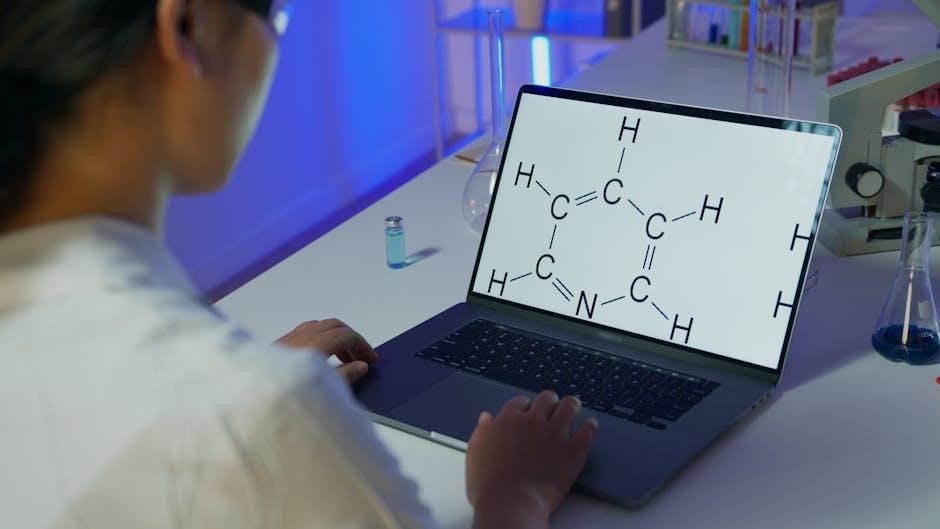
While the ACS exam primarily focuses on core concepts, familiarity with advanced topics is beneficial. Aromatic compounds, including benzene and its derivatives, are frequently encountered, requiring understanding of resonance and stability. Stereochemistry, encompassing enantiomers, diastereomers, and chirality, demands visualization skills and knowledge of R/S configurations.
Spectroscopic techniques, beyond basic interpretation, may involve complex analyses. Understanding reaction mechanisms beyond simple additions and substitutions is also helpful. These advanced areas often appear in more challenging exam questions, demonstrating a deeper comprehension of organic chemistry principles.

XIII.1. Aromatic Compounds
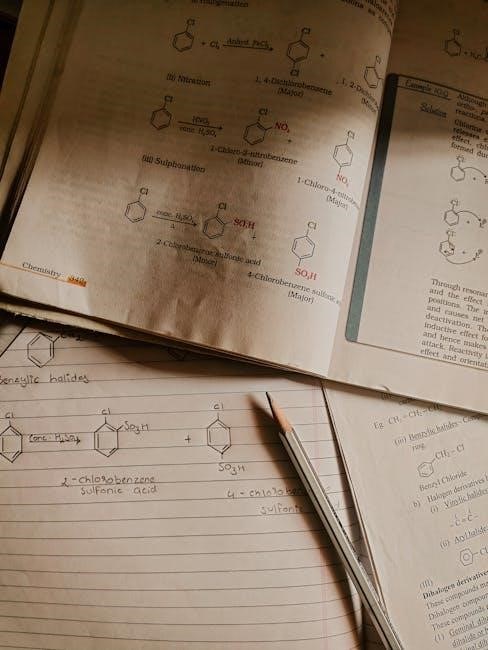
Aromatic compounds, notably benzene, represent a crucial advanced topic for the ACS exam. Mastery requires understanding Huckel’s rule – a 4n+2 π electron system exhibiting exceptional stability. Resonance structures are key to explaining aromaticity, delocalization, and reactivity. Electrophilic aromatic substitution (EAS) reactions, including halogenation, nitration, and sulfonation, are frequently tested.
Understanding directing effects of substituents (ortho/para vs. meta) is vital for predicting product formation. Polycyclic aromatic hydrocarbons (PAHs) and their unique properties may also appear. Recognizing aromaticity’s impact on reactivity compared to alkenes is essential for success.
XIII.2. Stereochemistry
Stereochemistry is a consistently important, and often challenging, area on the ACS organic chemistry exam. Students must grasp chiral centers, enantiomers, diastereomers, and their properties. Assigning R/S configurations accurately is critical, alongside understanding optical activity and racemic mixtures. Conformational analysis, utilizing Newman projections, is essential for evaluating stability.
E2 elimination reactions and their stereochemical outcomes (anti-periplanar geometry) are frequently tested. Understanding meso compounds – achiral despite possessing chiral centers – is also vital. Recognizing stereoisomers and their impact on reaction mechanisms demonstrates a strong grasp of fundamental concepts.

XIV. Practice Exam Analysis and Review
Thorough practice exam analysis is paramount for ACS organic chemistry success. Don’t simply check answers; meticulously review every question, correct or incorrect. Identify recurring error patterns – are you consistently missing mechanism questions, or struggling with spectroscopy?
Focus on understanding why an answer is correct, not just memorizing it. Revisit the relevant concepts in your study guide for areas of weakness. Utilize the exam as a diagnostic tool to pinpoint specific topics needing further attention. Time yourself during practice to simulate exam conditions and refine your pacing strategy.
XV. Resources for Further Study

Beyond core study guides, several resources bolster ACS organic chemistry preparation. Explore online platforms like Khan Academy and MIT OpenCourseware for supplementary lectures and practice problems. Textbooks beyond the required course material can offer alternative explanations of complex concepts.
Don’t underestimate the power of study groups – collaborative learning can clarify difficult topics. Utilize flashcard apps like Anki for efficient memorization of reactions and reagents. Lebedev’s work on mass spectrometry provides deeper insight into analytical techniques. Remember to critically evaluate resource quality and align them with the ACS exam scope.
Successfully tackling the ACS organic chemistry exam demands a strategic and comprehensive study approach. PDF study guides serve as a foundational resource, but effective preparation extends beyond simple memorization. Focus on understanding reaction mechanisms, mastering spectroscopic techniques (NMR, IR, MS), and consistently practicing problem-solving.
Leverage available online resources and practice exams to simulate the exam environment. Prioritize core concepts like structure, bonding, and functional groups. Remember that consistent effort and a well-defined study plan are key to achieving a strong score on this challenging assessment.